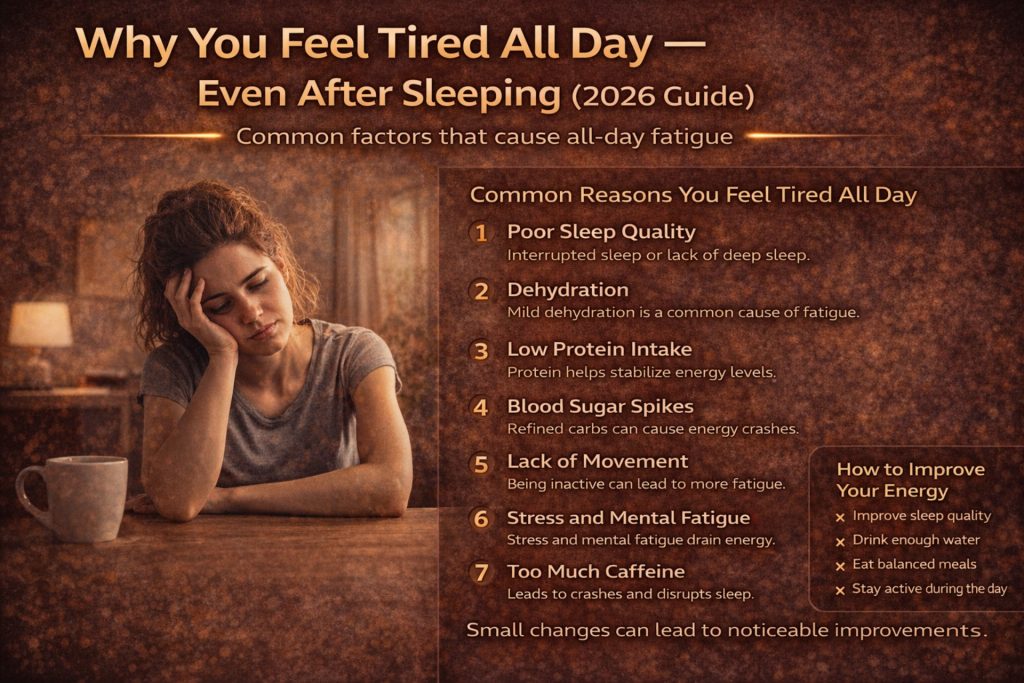
Why You Feel Tired All Day — Even After Sleeping (2026 Guide)
You slept seven, maybe eight hours last night. By every measure, that should be enough. And yet by mid-morning you are already reaching for your second coffee, struggling to concentrate, and wondering why you feel just as exhausted as if you had barely slept at all.
This is one of the most common and most misunderstood health complaints of modern life. The instinct is to blame the sleep itself — to assume you need more hours, a better mattress, or an earlier bedtime. But in most cases, the hours are not the problem. The quality of your sleep, your nutrition, your hydration, your movement patterns, and your stress levels are all equally responsible for how energized you feel throughout the day.
This guide breaks down the seven most common reasons for persistent daytime fatigue — and gives you a clear, actionable path to fixing each one.
Why Sleeping Longer Is Not Always the Answer
Sleep duration is only one variable in a complex equation. Your body’s ability to generate and sustain energy throughout the day depends on a network of interconnected systems — hormonal, metabolic, neurological, and behavioral — that are all running simultaneously.
When any one of these systems is disrupted, fatigue follows, regardless of how many hours you spent in bed.
Think of it this way: a phone plugged into a faulty charger overnight does not wake up at 100%. The time connected to the charger was not the problem — the quality of the charge was.
7 Reasons You Feel Tired All Day
- Poor Sleep Quality
Eight hours of broken, shallow sleep does not deliver the same restorative benefit as deep, uninterrupted sleep.
Alcohol, screen exposure, and inconsistent sleep times all reduce deep sleep and REM sleep.
The result is that you slept, but did not recover.
Fix: Maintain a consistent sleep schedule, avoid screens before bed, and keep your sleep environment cool and dark.
- Dehydration
Even mild dehydration can reduce focus, energy, and mood.
Many people feel tired simply because they are not drinking enough water.
Fix: Drink water immediately after waking and stay hydrated throughout the day.
- Low Protein Intake
Protein supports energy levels and helps stabilize blood sugar.
Low protein intake can lead to fatigue and poor concentration.
Fix: Include protein in every meal, especially breakfast.
- Blood Sugar Spikes and Crashes
Refined carbohydrates can cause rapid spikes and drops in blood sugar.
This leads to energy crashes and fatigue.
Fix: Eat balanced meals with protein, fiber, and healthy fats.
- Lack of Movement
Being inactive can reduce energy levels.
Movement increases circulation and improves alertness.
Fix: Add short walks or light activity throughout the day.
- Stress and Mental Fatigue
Stress increases cortisol, which drains energy and affects sleep.
Mental fatigue can be as exhausting as physical fatigue.
Fix: Take breaks, manage stress, and allow time for recovery.
- Too Much Caffeine
Caffeine can improve alertness short-term but lead to crashes later.
It can also disrupt sleep if consumed too late.
Fix: Limit caffeine intake and avoid it in the afternoon.
A Simple Daily Framework for Better Energy
Wake up at a consistent time
Drink water immediately
Eat a protein-rich breakfast
Move your body early in the day
Take short breaks throughout the day
Avoid caffeine later in the day
Maintain a consistent sleep routine
Conclusion
Feeling tired all day is not normal.
It is usually caused by habits that can be improved.
By making small, consistent changes, you can significantly improve your energy and overall well-being.
Start with one habit, build consistency, and the results will follow.