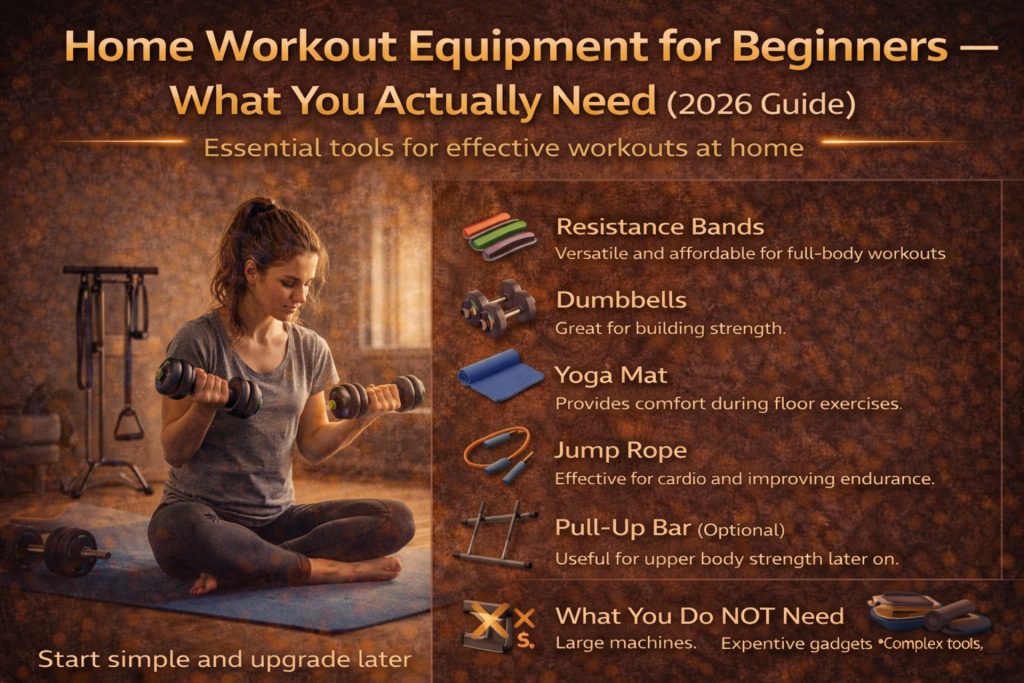
[Introduction]
One of the first questions every beginner asks when starting a home workout routine is: what do I actually need to buy? Walk into any sporting goods store or scroll through fitness content online and you will be confronted with an overwhelming array of equipment — resistance bands, dumbbells, kettlebells, foam rollers, pull-up bars, ab wheels, and machines that cost more than a year of gym membership.
The reality is far simpler. Most beginners need very little to get started — and buying too much too soon is one of the most common ways people waste money and create unnecessary complexity before they have even built a consistent habit. This guide cuts through the noise and tells you exactly what is worth buying, what can wait, and what you can skip entirely.
[Do You Even Need Equipment?]
Before spending anything, it is worth being honest about where you are starting from. If you have never trained consistently before, bodyweight exercises alone — squats, push-ups, lunges, planks, and jumping jacks — will produce real, measurable strength and fitness gains for the first several weeks to months. Your body does not know the difference between a barbell and your own bodyweight when it comes to producing a training stimulus. What it responds to is progressive challenge applied consistently over time.
Equipment becomes genuinely useful once you have outgrown the challenge that pure bodyweight provides, or when you want to target specific muscle groups more effectively. At that point, even a small investment in the right tools can significantly expand what is possible in a home training environment.
The key word is right. Not most. Not expensive. Right.
[Essential Equipment for Beginners]
- Resistance Bands
Resistance bands are the single best first purchase for a home gym beginner — and it is not particularly close. For the price of one or two gym visits, a set of resistance bands gives you the ability to add variable resistance to almost every exercise in your routine, train every major muscle group, and create enough progressive overload to drive meaningful strength development for months.
Unlike dumbbells, bands provide accommodating resistance — meaning the tension increases as you stretch the band further, which matches the natural strength curve of most exercises. This makes them particularly effective for movements like rows, pull-aparts, bicep curls, lateral band walks, and glute bridges.
A quality set of loop bands typically comes in four to five resistance levels, allowing you to scale any exercise up or down. They also pack into a small bag, making them the most space-efficient and travel-friendly piece of training equipment available.
What to buy: A set of five loop resistance bands in varying resistance levels (light to heavy). Expect to spend $15–35 for a reliable set.
✅ Best for: Full-body resistance training, glute and hip work, upper body pulling movements, warm-up activation - Dumbbells
Dumbbells are the most versatile free weight tool available and the natural next step once bodyweight and resistance band training no longer provide sufficient challenge. They allow for a wider range of loading options, more precise progression, and access to exercises — like dumbbell presses, rows, Romanian deadlifts, and lateral raises — that are difficult to replicate effectively with bands alone.
For beginners, a fixed set of two to three pairs of dumbbells at different weights covers the majority of training needs. A light pair (5–8 kg) for shoulder and arm isolation work, a medium pair (10–15 kg) for compound movements like rows and goblet squats, and a heavier pair if budget allows.
Adjustable dumbbells are worth considering if space is a constraint. A single pair of adjustable dumbbells can replace an entire rack of fixed weights, making them cost-efficient over time even if the upfront price is higher. The main downside is slower weight changes between sets, which can disrupt workout flow.
What to buy: Start with two or three fixed pairs covering a light-to-moderate weight range, or invest in a quality adjustable dumbbell set if budget permits.
✅ Best for: Strength building, progressive overload, compound and isolation exercises - Yoga Mat
A good quality exercise mat is one of the most underrated pieces of home gym equipment. While it may seem like a minor addition, training on a hard floor without cushioning significantly increases discomfort during floor-based exercises — which subtly reduces your effort and makes you less likely to complete sessions fully.
A quality mat provides joint cushioning for movements like planks, push-ups, core work, and stretching, while also offering a non-slip surface that improves stability and safety during dynamic movements. It also defines your workout space, which has a small but real psychological effect on consistency — having a dedicated area for training makes it feel more intentional.
Look for a mat that is at least 6 mm thick for adequate cushioning, made from non-slip material on both surfaces, and long enough to accommodate your full body height when lying down.
What to buy: A 6–8 mm non-slip TPE or rubber exercise mat. Avoid very thin foam mats that compress immediately under bodyweight.
✅ Best for: Floor exercises, core training, stretching, yoga, and any ground-based movement - Jump Rope
Jump rope is one of the most efficient and underutilized cardio tools available, and it costs almost nothing. A quality jump rope costs less than a single session at most fitness studios and delivers a genuinely intense cardiovascular workout in 10–15 minutes — more calorie burn per minute than jogging, with less joint impact than running on hard surfaces.
Beyond calorie burning, consistent jump rope training improves coordination, timing, foot speed, and cardiovascular endurance in ways that most other home cardio options cannot replicate. It also develops calf strength and ankle stability, which carry over directly to better performance in squats, lunges, and other lower body exercises.
For beginners, a basic PVC speed rope with adjustable length is sufficient. Weighted jump ropes add an upper body conditioning component and are worth considering once basic skipping technique is established.
What to buy: An adjustable PVC or steel cable jump rope. Expect to spend $10–25 for a quality beginner option.
✅ Best for: Cardio conditioning, warm-up, calorie burn, coordination development - Pull-Up Bar (Optional — Add Later)
A pull-up bar is one of the most valuable pieces of upper body training equipment available for home use, but it is correctly categorized as an optional addition rather than an essential starting point. Pull-ups and chin-ups are among the most effective upper body exercises in existence — targeting the lats, biceps, rear deltoids, and core simultaneously — but they require a baseline level of upper body strength that most beginners have not yet developed.
Attempting pull-ups before that foundation is in place leads to frustration, poor form, and potential shoulder strain. The more productive approach is to build upper body pulling strength through resistance band rows, dumbbell rows, and band-assisted pull-down movements for the first 6–8 weeks, then introduce a pull-up bar once the prerequisite strength is in place.
Door-mounted pull-up bars are the most practical option for most home environments — they require no installation, support significant bodyweight, and can be removed easily. Look for models that distribute weight across the door frame rather than relying solely on the door trim.
What to buy: A door-mounted pull-up bar with multiple grip positions. Add this after 6–8 weeks of consistent training.
✅ Best for: Upper body pulling strength, lat development, core stability under load
[What You Do NOT Need]
Large cable machines, multi-station home gyms, and exercise machines of any kind are unnecessary for beginners and represent poor value compared to free weights and bodyweight training. Machines lock you into fixed movement patterns that do not develop the stabilizer muscles or functional strength that free weight and bodyweight training produce. They also cost thousands of dollars, require significant space, and become obsolete quickly as your fitness level advances.
Ab rollers, foam rollers, balance boards, ankle weights, and fitness trackers are all secondary purchases that can add value eventually but should not be priorities before you have a consistent training habit established. The return on investment for these items is far lower than the five essential pieces listed above.
The instinct to buy more equipment to feel more prepared is extremely common among beginners — and it is almost always a form of productive procrastination. The best equipment is the equipment you actually use. Start minimal and add only when a specific gap in your training genuinely requires it.
[How to Choose Equipment: A Simple Framework]
Before purchasing any piece of fitness equipment, run it through four questions. Is it affordable — does it fit within a budget that does not require financial strain to maintain? Is it space-efficient — can it be stored without disrupting your living environment? Is it versatile — does it support multiple exercises and muscle groups rather than one specific movement? And is it easy to use — will it lower the barrier to training rather than adding complexity?
Equipment that scores well on all four criteria will serve you for years. Equipment that fails on any of them tends to end up unused within weeks.
For most beginners, the complete starter kit — resistance bands, one to two pairs of dumbbells, a yoga mat, and a jump rope — costs between $60 and $120 total and covers everything needed for a complete, progressive training program for the first six to twelve months.
[Conclusion]
The home gym that produces results is not the most expensive one — it is the one that removes every possible excuse not to train. A resistance band set, a pair of dumbbells, a mat, and a jump rope give you everything you need to build real strength, improve cardiovascular fitness, and create a consistent training habit without a gym membership, a large budget, or significant space.
Start with what you need. Build the habit first. Upgrade the equipment when your training genuinely demands it — not before.
The best equipment purchase you can make right now is the one that gets you moving today.
⚠️ Disclaimer: This article is for informational purposes only. Product recommendations are based on general use cases. Always consult a fitness professional if you are unsure which equipment is appropriate for your specific goals or physical condition.