[Introduction]
Starting a fitness routine is one of the best decisions you can make for your health — but for most beginners, the barrier to entry feels enormous. Gym memberships are expensive. Exercise programs are complicated. And the fitness industry makes everything look far more difficult than it needs to be.
Here is the truth: you do not need a gym, equipment, or a personal trainer to get real results. Bodyweight training done consistently at home has been shown to build meaningful strength, improve cardiovascular fitness, and support fat loss — especially for beginners, who respond strongly to almost any form of structured exercise. The key is having a plan, executing it with proper form, and showing up regularly.
This guide gives you exactly that — a simple, effective beginner home workout routine backed by exercise science, with everything you need to get started today.
[Why Home Workouts Actually Work]
There is a common misconception that bodyweight training is a compromise — something you do when you cannot access a real gym. This is not supported by the evidence. For beginners especially, bodyweight exercises are highly effective because your body has no baseline strength to compare against. Every session produces a training stimulus that drives adaptation.
Compound bodyweight movements like squats, push-ups, and lunges engage multiple large muscle groups simultaneously, elevate heart rate, and create the hormonal environment needed for both strength development and fat loss. Research consistently shows that resistance training — regardless of whether it uses external weights or bodyweight — increases muscle mass, improves insulin sensitivity, and raises resting metabolic rate.
The advantage of home training is also psychological. Removing the commute, the cost, and the social anxiety of a gym dramatically reduces the friction between intention and action — which means you are far more likely to actually do it.
[The Beginner Home Workout Routine]
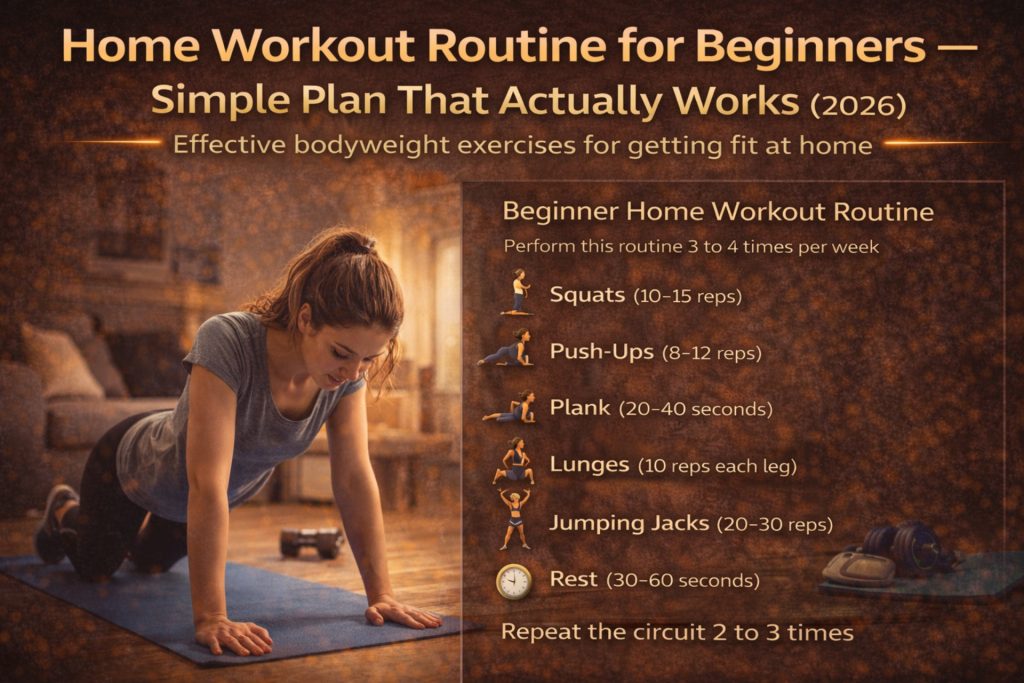
Perform this circuit 3 to 4 times per week, with at least one rest day between sessions. Complete all six exercises back to back with minimal rest between movements, then rest 60–90 seconds before repeating the circuit. Aim for 2–3 rounds per session.
- Squats — 10 to 15 reps
The squat is the single most important lower body exercise and a cornerstone of any effective workout routine. It targets the quadriceps, hamstrings, glutes, and core simultaneously, making it one of the highest-return movements you can perform without equipment.
Proper form is everything. Stand with feet shoulder-width apart and toes pointed slightly outward. Push your hips back and bend your knees as if sitting into a chair behind you. Keep your chest tall, your knees tracking over your toes, and your weight distributed through your full foot — not just the toes. Lower until your thighs are parallel to the ground or as close as your mobility allows, then drive through your heels to return to standing.
Do not rush. A controlled, full-range squat is far more valuable than a fast, shallow one.
✅ Progression: Add a 2-second pause at the bottom, increase reps to 20, or try a single-leg squat variation as you get stronger. - Push-Ups — 8 to 12 reps
Push-ups are one of the most complete upper body exercises available. They primarily train the chest, shoulders, and triceps, while also requiring significant core engagement to maintain a rigid body position throughout the movement.
Start in a high plank position with hands slightly wider than shoulder-width, arms straight, and body forming a straight line from head to heels. Lower your chest toward the floor by bending your elbows at roughly a 45-degree angle from your body — not flared out wide. Pause briefly at the bottom, then press back up to the starting position.
If full push-ups are too challenging initially, perform them with knees on the ground. This is not a lesser exercise — it is the correct starting point, and it will build the strength needed to progress to full push-ups within a few weeks.
✅ Progression: Increase reps to 20, try close-grip push-ups for more tricep emphasis, or elevate your feet for a greater challenge. - Plank — 20 to 40 seconds
The plank is the most efficient core exercise for beginners because it trains the entire anterior chain — the abs, obliques, hip flexors, and lower back — under sustained tension without requiring any movement or spinal flexion.
Position yourself face down with forearms flat on the ground, elbows directly beneath your shoulders. Lift your body so only your forearms and toes are in contact with the floor. Your body should form a perfectly straight line from head to heels — hips neither raised nor sagging. Squeeze your glutes, brace your abs as if expecting a punch, and hold the position while breathing steadily.
The moment your hips drop or your lower back arches, the set is over. Quality of position matters far more than duration.
✅ Progression: Extend hold time to 60 seconds, try a single-leg plank, or progress to a plank with alternating shoulder taps. - Lunges — 10 reps each leg
Lunges complement squats by training each leg independently, which corrects muscle imbalances, improves balance, and develops functional strength that transfers directly to everyday movement like walking, climbing stairs, and changing direction.
Stand tall with feet together. Step one foot forward approximately 60–70 cm, lower your back knee toward the floor, and stop just before it touches the ground. Your front knee should track directly over your foot without caving inward. Push through the front heel to return to the starting position, then repeat on the opposite leg.
Keep your torso upright throughout — a common beginner mistake is leaning the upper body too far forward, which reduces glute activation and increases knee strain.
✅ Progression: Add a reverse lunge variation, increase reps to 15 per leg, or hold light objects at your sides for added resistance. - Jumping Jacks — 20 to 30 reps
Jumping jacks serve as the cardiovascular component of this circuit, elevating heart rate, increasing calorie burn, and improving cardiovascular endurance without requiring any equipment or space beyond what you already have.
They also function as an active recovery movement between more demanding strength exercises — keeping blood flowing to working muscles, maintaining elevated heart rate, and preventing the circuit from becoming purely static.
Perform them at a controlled, rhythmic pace rather than rushing. Focus on a full arm raise overhead and a wide leg position on each rep.
✅ Progression: Increase to 40–50 reps, substitute with high knees or mountain climbers for greater intensity, or add a second cardio exercise between circuits. - Rest — 30 to 60 seconds between circuits
Rest is not optional — it is part of the training. During rest periods, your muscles clear metabolic waste, your heart rate partially recovers, and your nervous system prepares for the next effort. Skipping or shortening rest too aggressively in the early weeks leads to degraded form, reduced output, and elevated injury risk.
As your fitness improves over several weeks, you can progressively shorten rest periods to increase workout intensity — but for the first 4 weeks, take the full rest you need.
[Complete Workout Summary]
Squats — 10–15 reps
Push-Ups — 8–12 reps
Plank — 20–40 seconds
Lunges — 10 reps each leg
Jumping Jacks — 20–30 reps
Rest — 60–90 seconds
Repeat 2–3 rounds total
Frequency: 3–4 times per week
Total session time: approximately 20–30 minutes
[How to Progress Over Time]
Progressive overload — the principle of gradually increasing the challenge placed on your muscles — is what separates training that produces results from training that plateaus. Your body adapts quickly to a given stimulus, which means the routine that challenged you in week one will feel easy by week four. That is a sign of progress, not a reason to stop.
Progression for bodyweight training follows a clear hierarchy. First, increase reps within the given range. Once you reach the top of the range comfortably, add another set. Once you are completing three solid sets, introduce technique variations that increase difficulty — pauses, slower tempos, single-limb variations. After 6–8 weeks of consistent training, adding light resistance bands or dumbbells will take your results to the next level.
Track your workouts in a simple notebook or app. Seeing progression in black and white is one of the most powerful motivators in fitness.
[Common Mistakes Beginners Make]
Doing too much too fast is the most common and most damaging beginner mistake. Starting with daily intense sessions when your body has no training base leads to excessive soreness, joint irritation, and burnout — often causing people to quit within the first two weeks. Three to four sessions per week with rest days in between is optimal for beginners.
Skipping rest days is similarly counterproductive. Muscle growth and strength development do not happen during training — they happen during recovery. Rest days are when your body adapts to the training stress and comes back stronger. Without them, you accumulate fatigue and undermine the process.
Ignoring proper form in favor of completing more reps is a false economy. Poor form shifts stress away from the target muscles and onto joints, connective tissue, and stabilizers that are not equipped to handle it. One clean rep is always worth more than three sloppy ones.
[Conclusion]
The best workout routine is the one you will actually do — consistently, over months. A simple, well-structured home workout performed three to four times per week will produce real, visible results for any beginner. You do not need a gym, a trainer, or expensive equipment to build a stronger, leaner body.
Master the basics. Progress gradually. Prioritize form over speed. Rest between sessions. And show up even when motivation is low — especially then.
Six weeks from now, you will be stronger, more energetic, and more confident than you are today. Start with this routine tonight.
⚠️ Disclaimer: This article is for informational purposes only. Consult a physician or qualified fitness professional before beginning any new exercise program, especially if you have existing injuries or health conditions.