Why You’re Always Hungry — Even When You Just Ate
You finished a full meal an hour ago. And somehow, you are hungry again.
It is not a lack of willpower. It is not greed. And it is almost certainly not because you did not eat enough. Constant hunger is one of the most misunderstood signals your body sends — and most people spend years fighting it without ever understanding what is actually causing it.
Here is what is really going on.
Hunger Is Not Just About Calories
Most people think hunger works like a fuel gauge. Empty tank, feel hungry. Full tank, stop eating. Simple.
But your body does not work that way. Hunger is controlled by a complex system of hormones, blood sugar levels, gut signals, and even your stress response. Two people can eat the exact same meal and one will feel satisfied for four hours while the other is reaching for a snack within ninety minutes.
The difference is almost never about how much they ate. It is about what they ate, how they ate it, and what else is happening in their body.
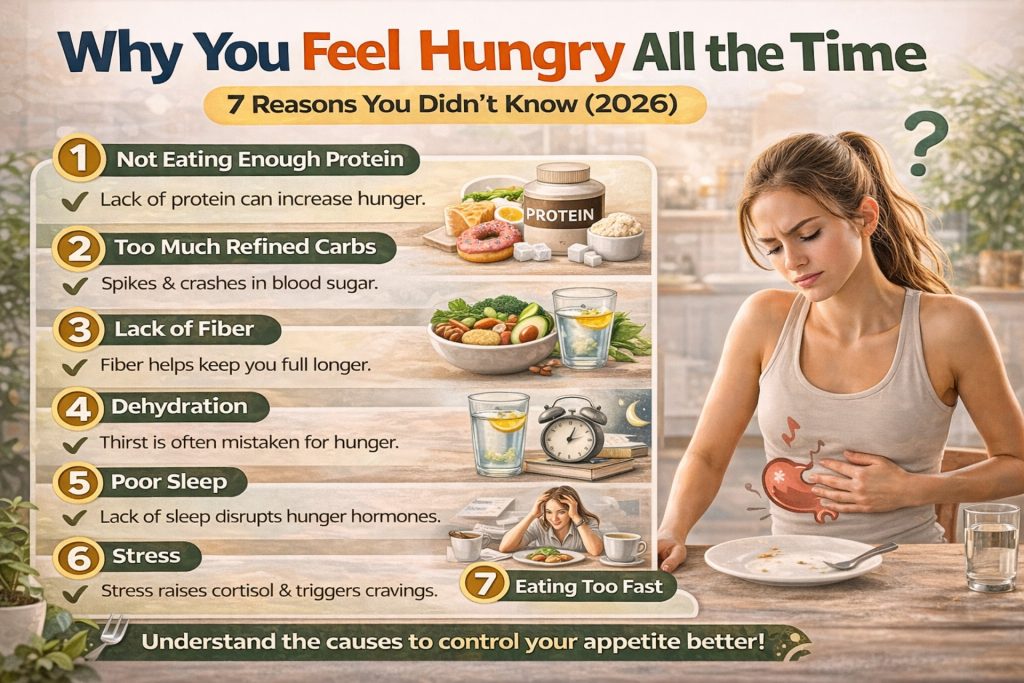
- You Are Not Eating Enough Protein — And This Is Probably the Biggest One
Of all the nutrients that affect hunger, protein has the most powerful and well-documented effect on satiety.
It slows digestion, keeping food in your stomach longer.
It triggers the release of satiety hormones including GLP-1 and peptide YY.
It suppresses ghrelin, the hormone most directly responsible for making you feel hungry.
Studies consistently show that increasing protein intake to around 25 to 30 percent of total calories significantly reduces overall appetite and calorie intake.
In practice, meals built around eggs, chicken, fish, legumes, or Greek yogurt will keep you full much longer than meals centered on refined carbs.
- Refined Carbohydrates Are Causing Blood Sugar Crashes
Foods like white bread, pasta, pastries, sugary cereals, and crackers are digested rapidly.
Your blood sugar spikes quickly, insulin rises, and then blood sugar drops — sometimes below baseline. Your brain interprets this as an emergency and triggers hunger again.
That is why you can eat a large carb-heavy meal and still feel hungry soon after.
The solution is not eliminating carbs, but combining them with protein, fat, and fiber to slow digestion.
- You Are Not Eating Enough Fiber
Fiber slows digestion and helps maintain stable blood sugar.
Soluble fiber (oats, beans, apples, flaxseed) forms a gel-like substance that delays digestion.
Insoluble fiber (vegetables, whole grains, nuts) adds bulk and supports gut health.
Most people consume far less than the recommended 25–38 grams per day, which contributes to frequent hunger.
- You Are Mistaking Thirst for Hunger
Your brain regulates hunger and thirst using similar signals.
Mild dehydration is often misinterpreted as hunger, leading to unnecessary snacking.
A simple habit: drink a glass of water and wait 10 minutes before eating. If the feeling fades, it was likely thirst.
- Poor Sleep Is Disrupting Your Hunger Hormones
Even one night of poor sleep can increase ghrelin (hunger hormone) and decrease leptin (fullness hormone).
This makes you feel hungrier and less satisfied after eating.
Sleep-deprived individuals tend to consume significantly more calories, especially from high-carb foods.
- Chronic Stress Is Increasing Your Appetite
Stress triggers cortisol, which increases appetite — particularly for calorie-dense foods.
Modern stress does not require extra calories, but your body still responds as if it does.
This leads to persistent hunger and cravings unrelated to actual energy needs.
- You Are Eating Too Fast
There is a delay of about 15 to 20 minutes between eating and feeling full.
If you eat too quickly, your brain does not have time to register fullness.
Slowing down — chewing thoroughly, pausing between bites, and avoiding distractions — helps regulate intake naturally.
How to Actually Control Constant Hunger
Instead of relying on willpower, work with your body:
Build meals around protein and fiber.
Eat at consistent times.
Stay hydrated throughout the day.
Prioritize sleep.
Slow down when eating.
The Bottom Line
Constant hunger is not a lack of discipline. It is a signal.
Your body is telling you that something in your routine needs adjustment — whether it is your diet, sleep, hydration, or stress levels.
Fix the root cause, and the hunger will naturally decrease.