[Introduction]
You are tracking your food. You are cutting calories. You are putting in the effort — and yet the scale barely moves. Sound familiar?
The frustrating truth is that weight loss plateaus and slow progress are rarely about effort. They are almost always about specific, fixable mistakes that quietly cancel out the work you are doing. Most of these mistakes are not obvious, which is exactly why so many people keep making them.
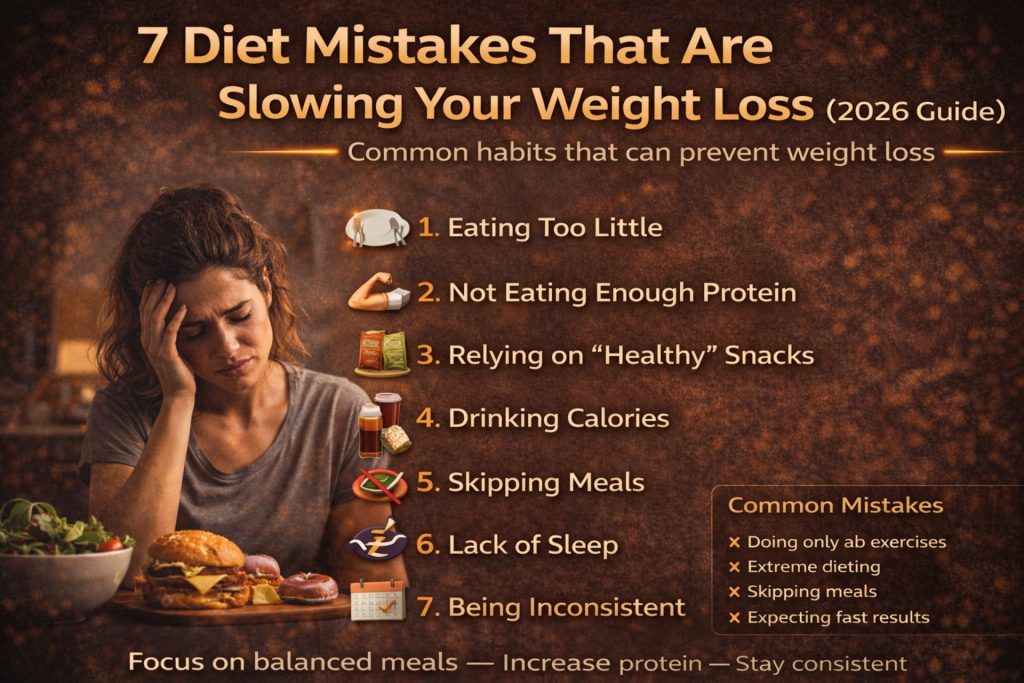
This guide covers the seven most common diet mistakes that slow weight loss — and more importantly, exactly how to fix each one.
- Eating Too Little
It sounds counterintuitive, but eating too few calories is one of the most common reasons weight loss stalls. When you cut calories too aggressively — typically below 1,200 calories for women or 1,500 for men — your body interprets the shortage as a threat and responds by lowering your metabolic rate to conserve energy.
This is known as adaptive thermogenesis. Your body becomes more efficient at surviving on less, which means it burns fewer calories throughout the day. You end up eating very little while losing very little — a frustrating combination that is entirely avoidable.
The fix is not to eat more junk food — it is to eat enough whole food, especially protein, to keep your metabolism running at full capacity. A moderate deficit of 300–500 calories below your maintenance level produces steady, sustainable fat loss without triggering metabolic adaptation.
✅ Fix: Calculate your TDEE (Total Daily Energy Expenditure) and aim for a 300–500 calorie deficit — no more. - Not Eating Enough Protein
If there is one dietary variable that matters most for body composition, it is protein. Most people trying to lose weight significantly undereat protein — and it costs them in ways they do not always see on the scale.
Without adequate protein, your body has no choice but to break down muscle tissue for energy during a calorie deficit. Less muscle means a lower resting metabolic rate, which means your body burns fewer calories at rest. You lose weight, but a significant portion of that weight is muscle rather than fat — leaving you softer, not leaner.
Protein also has a powerful effect on hunger. It lowers ghrelin (the hunger hormone) and increases satiety hormones, naturally reducing the urge to overeat. Studies show that simply increasing protein intake to 30% of total calories can reduce daily calorie consumption by up to 441 calories without any deliberate restriction.
✅ Fix: Aim for 1.6–2.2 grams of protein per kilogram of body weight daily. Prioritize eggs, chicken, fish, Greek yogurt, cottage cheese, and legumes at every meal. - Relying on “Healthy” Snacks
The health food industry has successfully convinced millions of people that certain snacks are diet-friendly — and that belief is quietly sabotaging a lot of weight loss efforts. Granola bars, trail mix, rice cakes, fruit smoothies, protein bars, and even nuts are commonly perceived as safe options, but many contain far more calories than people realize.
A single handful of mixed nuts contains around 170 calories. A store-bought protein bar can contain 300–400 calories with significant added sugar. A large fruit smoothie can exceed 500 calories. None of these are bad foods, but eating them mindlessly while believing they are essentially calorie-free will reliably prevent fat loss.
The problem is not the food itself — it is the unconscious consumption driven by a health halo effect. If a food is labeled organic, natural, or high-protein, people consistently underestimate how many calories it contains.
✅ Fix: Track your snacks honestly for one week. You will likely be surprised. Replace high-calorie snacks with lower-calorie, high-volume options like vegetables with hummus, plain Greek yogurt, or boiled eggs. - Drinking Your Calories
Liquid calories are the most invisible source of excess calorie intake in the modern diet. The problem is not just sugary sodas and juices — it is the full range of beverages that most people never account for: flavored coffees, lattes, oat milk, sports drinks, smoothies, protein shakes, and alcohol.
A medium caramel latte can contain 250–400 calories. A glass of orange juice contains nearly as much sugar as a can of soda. Two glasses of wine add up to 300 calories with essentially zero nutritional benefit. The core issue is that liquid calories do not trigger the same satiety signals as solid food, so you consume them on top of your regular intake rather than instead of it.
Research consistently shows that people who drink their calories do not compensate by eating less — meaning every liquid calorie beyond water is essentially extra, unaccounted intake.
✅ Fix: Drink water, black coffee, and plain tea as your defaults. Audit every beverage you consume in a day — including the ones you consider healthy. - Skipping Meals
Skipping meals — particularly breakfast — feels like an easy way to cut calories, but for most people it backfires significantly by the end of the day. When you arrive at lunch or dinner in a state of extreme hunger, your ability to make controlled, rational food choices drops dramatically. Portion sizes increase, food choices worsen, and eating speed accelerates — all of which lead to consuming far more calories than the skipped meal would have contained.
Skipping meals also destabilizes blood sugar levels, leading to energy crashes, brain fog, and intense cravings for fast-digesting carbohydrates and sugar. This creates a cycle of restriction followed by overeating that prevents any meaningful calorie deficit from forming.
Note: Intentional intermittent fasting with a defined eating window is different from unplanned meal skipping. Structured fasting works when total calorie intake is still controlled. Reactive meal skipping typically is not.
✅ Fix: Eat regular, balanced meals spaced throughout the day. If you are not hungry in the morning, a small high-protein option is better than skipping entirely. - Not Getting Enough Sleep
Sleep deprivation may be the most underestimated obstacle to weight loss. When you sleep fewer than 7 hours per night, two hunger-regulating hormones shift in the worst possible direction: ghrelin (which stimulates appetite) increases significantly, while leptin (which signals fullness) decreases. The result is that you feel hungrier, feel full later, and crave calorie-dense foods — particularly sugar and refined carbs — far more intensely than usual.
Research published in the Annals of Internal Medicine found that sleep-deprived dieters lost 55% less fat compared to those who slept adequately, even while eating identical diets. Lack of sleep also elevates cortisol, which promotes abdominal fat storage and further disrupts metabolism.
No diet or exercise program can fully compensate for chronic sleep deprivation. It is not a lifestyle luxury — it is a biological requirement for effective fat loss.
✅ Fix: Prioritize 7–9 hours of quality sleep. Set a consistent wake time every day, limit screens an hour before bed, and keep your bedroom cool and dark. - Being Inconsistent
This is the mistake that undermines all the others. Eating well Monday through Friday while significantly overeating on weekends creates what researchers call social jetlag — a cycle where calorie deficits built during the week are routinely erased over the weekend. Studies show that the average person consumes 400–500 extra calories per day on weekends compared to weekdays, which is enough to completely negate a week of disciplined eating.
The same pattern plays out across different contexts: being strict during low-stress periods but abandoning all habits during travel, holidays, or difficult emotional periods. The issue is treating healthy eating as a temporary mode rather than a default approach.
Sustainable weight loss is not built on perfect weeks — it is built on avoiding catastrophic inconsistency. An 80–85% consistency rate over several months will outperform any extreme diet followed for two weeks.
✅ Fix: Plan for weekends and social events rather than treating them as diet-free zones. Allow flexibility within your calorie targets, not unlimited exceptions outside of them.
[How to Fix All 7 Mistakes: Summary]
The seven mistakes above share a common thread — they are all habits that seem reasonable in isolation but quietly undermine your calorie deficit and hormonal balance over time. The fix does not require perfection. It requires awareness and a few targeted adjustments.
Eat enough to support your metabolism. Make protein the centerpiece of every meal. Track what you drink. Audit your snacks honestly. Eat consistently throughout the day. Sleep like it is part of your training. And show up with the same effort on Saturday as you do on Tuesday.
These are not dramatic changes. But compounded over weeks and months, they are the difference between frustrating plateaus and real, visible progress.
[Conclusion]
Weight loss that stalls is almost never a motivation problem. It is a strategy problem. The seven mistakes in this guide are not failures of willpower — they are knowledge gaps that are completely fixable once you know what to look for.
Audit your current habits honestly, identify which of these mistakes apply to you, and focus on correcting one or two at a time. You do not need to overhaul everything at once. Small, precise corrections to the right habits will produce far better results than trying harder at the wrong approach.
⚠️ Disclaimer: This article is for informational purposes only and does not constitute medical advice. Consult a healthcare or nutrition professional before making significant changes to your diet.