[Introduction]
Most people treat mornings as something to survive rather than something to design. The alarm goes off, the phone comes out, coffee gets made, and the day begins in a state of reactive stress before it has even properly started.
But research into circadian biology, cortisol rhythms, and behavioral psychology consistently points to the same conclusion: the first 60–90 minutes of your day have a disproportionate influence on your energy, focus, mood, and productivity for everything that follows.
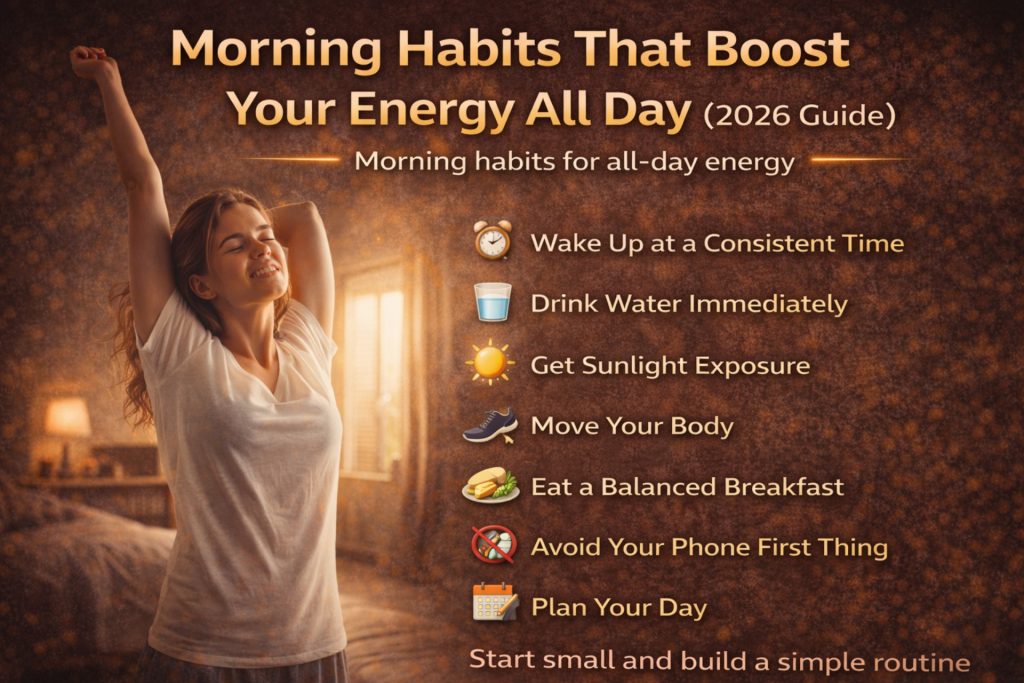
You do not need a complicated routine or an hour of meditation. You need the right habits, in the right order, done consistently. This guide breaks down seven of the most evidence-backed morning habits that actually move the needle on all-day energy.
[Why Morning Habits Matter More Than You Think]
Your body runs on a 24-hour internal clock called the circadian rhythm. This biological system governs when you feel alert, when you feel tired, when your metabolism peaks, and when your hormones shift. The inputs that set and reinforce this clock — light exposure, movement, food timing, and consistent wake times — are all concentrated in the morning hours.
When you consistently feed your circadian rhythm the right signals in the morning, your body learns to generate natural energy at the right time. When you disrupt those signals — through irregular wake times, immediate screen exposure, skipping breakfast, or staying indoors — your body stays in a confused, low-energy state for hours.
The morning habits below are not arbitrary wellness advice. Each one works through a specific biological or psychological mechanism that science has documented repeatedly.
- Wake Up at a Consistent Time
Of all the habits on this list, this one has the most foundational impact. Your internal clock is anchored primarily to your wake time — not your bedtime. When you wake up at the same time every day, including weekends, your body learns to anticipate wakefulness and begins preparing for it in advance by gradually raising core body temperature, releasing cortisol, and suppressing melatonin.
The result is that you wake up feeling more alert and less groggy — not because you slept more hours, but because your biology was ready for the transition.
Irregular wake times — even varying by 60–90 minutes on weekends — disrupt this calibration and create a form of social jetlag that leaves you feeling sluggish for days. Consistency is the mechanism, and it costs nothing.
✅ Fix: Set a fixed wake time and hold it 7 days a week for at least 2–3 weeks. Your body will adapt, and morning alertness will improve noticeably. - Drink Water Immediately After Waking
After 7–9 hours without any fluid intake, your body wakes up in a mild state of dehydration every single morning. Even mild dehydration — as little as 1–2% of body weight — has been shown to impair cognitive performance, reduce concentration, increase fatigue, and worsen mood.
Drinking 400–500 ml of water within the first few minutes of waking rehydrates your cells, kickstarts digestion, and supports the natural cortisol awakening response — a healthy spike in cortisol that occurs in the first 30–45 minutes after waking and is your body’s built-in mechanism for producing morning alertness.
Adding a small pinch of sea salt or a squeeze of lemon can further support electrolyte balance and absorption, though plain water is effective on its own.
✅ Fix: Place a glass or bottle of water on your nightstand before bed so it is the first thing you reach for — not your phone. - Get Sunlight Exposure Within 30 Minutes
This is one of the most powerful and most overlooked morning habits in modern life. Natural light — particularly the full-spectrum light available outdoors in the morning — is the primary signal your brain uses to set its internal clock, suppress residual melatonin, and trigger the cortisol awakening response.
Neuroscientist Andrew Huberman’s research highlights that getting 10–30 minutes of outdoor light exposure within 30–60 minutes of waking has measurable effects on daytime alertness, nighttime sleep quality, and mood regulation. Indoor lighting, even very bright indoor lighting, does not produce the same effect because it lacks the intensity and spectrum of natural sunlight.
On overcast days, the effect is reduced but still present — outdoor light on a cloudy day is still significantly more intense than indoor lighting. The key is getting outside, not just near a window.
✅ Fix: Take your morning water outside. A 10-minute walk or simply sitting on a porch or balcony in the morning light is enough to activate this mechanism. - Move Your Body
Morning movement does not need to be intense to be effective. Even light physical activity — a 10-minute walk, a short stretching routine, or a few sets of bodyweight exercises — produces a cascade of biological benefits that directly increase energy and mental clarity.
Movement increases blood flow and oxygen delivery to the brain, raises core body temperature (which is associated with alertness), and triggers the release of dopamine and norepinephrine — neurotransmitters that sharpen focus and motivation. It also reduces morning cortisol to healthy levels after the initial awakening spike, preventing the anxious, wired-but-tired feeling that many people experience.
For those with more time and fitness goals, a full strength training or cardio session in the morning produces even greater benefits — including improved insulin sensitivity and elevated metabolism for hours afterward.
✅ Fix: Start with just 5–10 minutes of movement. A brisk walk combined with sunlight exposure covers two habits simultaneously and is one of the highest-return morning investments available. - Eat a Balanced Breakfast
Skipping breakfast may work as part of a structured intermittent fasting protocol, but for most people who are not deliberately fasting, skipping the morning meal leads to blood sugar instability, intensified hunger, poor food choices later in the day, and significantly lower cognitive performance during the morning hours.
A breakfast built around protein, healthy fats, and complex carbohydrates provides stable, sustained energy by avoiding the blood sugar spike-and-crash cycle that sugary cereals, pastries, and fruit juices create. Protein in particular is critical — it promotes satiety, supports neurotransmitter production, and preserves muscle mass.
Practical high-energy breakfast options include eggs with vegetables and whole grain toast, Greek yogurt with berries and nuts, oatmeal with protein powder and nut butter, or a savory bowl with eggs, avocado, and legumes.
✅ Fix: Build your breakfast around a protein source first, then add complex carbs and healthy fats. Aim for at least 25–30 grams of protein at your first meal. - Avoid Your Phone for the First 30 Minutes
Reaching for your phone immediately after waking is one of the most damaging habits for morning energy and mental clarity — and it is also one of the most universal. Within seconds of opening your phone, your brain is flooded with notifications, news, emails, and social media updates that immediately activate the stress response system.
This puts your brain into reactive mode before you have had any time to orient yourself, set intentions, or allow your prefrontal cortex — the part responsible for focus and decision-making — to come fully online. The result is a morning spent feeling scattered, anxious, and mentally depleted before the day has truly begun.
Protecting the first 30 minutes of your morning from incoming information gives your brain time to transition into wakefulness naturally, allows your cortisol levels to normalize, and lets you engage with your day proactively rather than reactively.
✅ Fix: Keep your phone in another room or face down until after your morning routine is complete. Replace the scrolling habit with water, sunlight, or movement instead. - Plan Your Day With Intention
Taking 5–10 minutes each morning to review your priorities and plan your day is a small habit with outsized returns on productivity and mental energy. The act of writing down your top 2–3 priorities for the day reduces cognitive load — your brain no longer needs to hold everything in working memory — and creates a clear direction that reduces decision fatigue throughout the day.
Without a plan, most people drift reactively between tasks, emails, and distractions, ending the day having been busy but not productive. With even a minimal plan, you move through the day with clarity and purpose, which reduces stress and preserves mental energy for what matters most.
You do not need a complex system. A simple notebook with three questions — What are my top priorities today? What would make today successful? What can I eliminate or postpone? — is enough to make a measurable difference.
✅ Fix: Keep a notebook by your coffee or breakfast spot. Spend 5 minutes planning before you look at email or messages.
[How to Build Your Routine Without Overwhelm]
You do not need to implement all seven habits at once. In fact, trying to overhaul your entire morning overnight is one of the most reliable ways to fail. Instead, stack habits gradually over several weeks.
Start with the two highest-impact habits: consistent wake time and morning sunlight exposure. Once those feel automatic — usually after 2–3 weeks — add water first thing and a brief movement session. Then layer in the remaining habits one at a time. By the time all seven are in place, none of them will feel like effort because each one will have become a default behavior.
The goal is not a perfect morning. It is a reliable morning that serves you most days. Even five of these seven habits done consistently will produce a significant and noticeable improvement in your daily energy.
[Conclusion]
Energy is not something that just happens to you in the morning. It is something your biology produces in response to specific inputs — and the morning is when those inputs matter most.
A consistent wake time, water, sunlight, movement, a protein-rich breakfast, a phone-free start, and a few minutes of planning are not complicated changes. But together, they create a morning that actively generates energy rather than one that passively drains it.
Start with one. Build from there. Within a month, your mornings — and the energy you carry through the rest of your day — will feel fundamentally different.
⚠️ Disclaimer: This article is for informational purposes only. Individual results may vary. Consult a healthcare professional if you experience persistent fatigue or sleep issues.