[Introduction]
You slept for 7–8 hours.
But you still wake up tired.
This is one of the most frustrating problems because it feels like you did everything right — yet your energy is still low.
The issue is not always the amount of sleep.
It is the quality of sleep and what happens inside your body during the night.
Understanding this difference is the key to fixing morning fatigue.
[Why Sleep Duration Alone Is Not Enough]
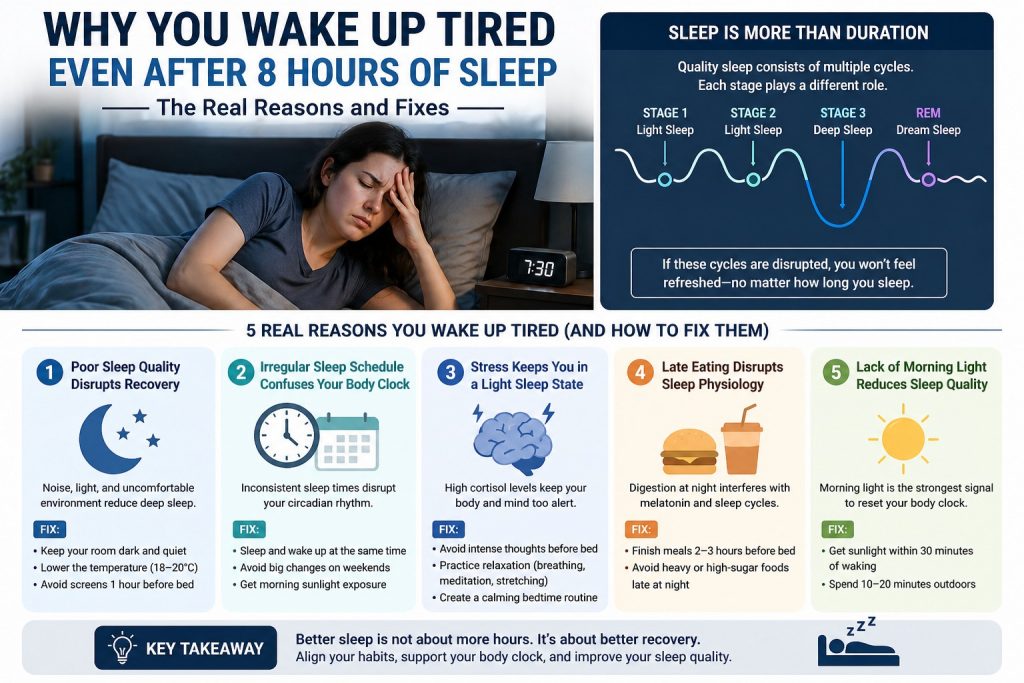
Sleep is not a single state.
It is made up of multiple cycles, including deep sleep and REM sleep.
Each stage plays a different role:
- Deep sleep restores physical energy
- REM sleep supports brain function and mood
If these cycles are disrupted, even long sleep duration will not feel refreshing.
Research from the National Sleep Foundation shows that poor sleep quality is more strongly associated with fatigue than total sleep time.
[Cause 1: Poor Sleep Quality Disrupts Recovery]
You may be sleeping long enough, but not deeply enough.
Factors such as noise, light, or stress can reduce deep sleep without waking you up fully.
This means your body never completes proper recovery.
👉 Fix: Improve Deep Sleep Conditions
Deep sleep depends heavily on environment.
This works because the brain enters deeper sleep stages when external disturbances are minimized.
How to apply:
- Keep your room dark and quiet
- Lower room temperature slightly (around 18–20°C)
- Avoid screen exposure 1 hour before sleep
When these conditions improve, your body spends more time in deep sleep, leading to better recovery.
[Cause 2: Irregular Sleep Schedule Confuses Your Body Clock]
Your body follows a circadian rhythm.
When your sleep time changes frequently, your internal clock cannot stabilize.
This leads to poor sleep quality even if total hours are sufficient.
👉 Fix: Stabilize Your Sleep Timing
Consistency improves sleep efficiency.
This works because your body learns when to release sleep hormones such as melatonin.
How to apply:
- Sleep and wake up at the same time every day
- Avoid large schedule shifts on weekends
- Expose yourself to sunlight in the morning
Within 1–2 weeks, your sleep cycle becomes more stable, improving morning energy.
[Cause 3: Stress Keeps Your Body in a Light Sleep State]
High stress levels increase cortisol.
When cortisol remains elevated at night, the body stays in a semi-alert state.
This prevents deep sleep and causes frequent micro-awakenings.
👉 Fix: Lower Nighttime Stress Response
Reducing stress before sleep improves sleep depth.
This works because lower cortisol allows the body to fully enter recovery mode.
How to apply:
- Avoid intense mental activity before bed
- Use simple relaxation methods (breathing, light stretching)
- Keep a consistent wind-down routine
This helps your body shift from alert mode to recovery mode more effectively.
[Cause 4: Late Eating Disrupts Sleep Physiology]
Eating late at night keeps your digestive system active.
This can interfere with melatonin production and disrupt sleep cycles.
👉 Fix: Adjust Meal Timing
Timing affects sleep quality.
This works because digestion and sleep compete for energy.
How to apply:
- Finish meals at least 2–3 hours before bed
- Avoid heavy or high-sugar meals late at night
This allows your body to fully focus on recovery during sleep.
[Cause 5: Lack of Morning Light Reduces Sleep Quality]
Morning light exposure is essential for regulating your sleep cycle.
Without it, your body struggles to maintain a consistent rhythm.
👉 Fix: Use Light to Reset Your Body Clock
Light is the strongest signal for circadian rhythm.
This works because it helps regulate melatonin production.
How to apply:
- Get sunlight within 30 minutes of waking
- Spend at least 10–20 minutes outdoors
- Avoid staying in dark indoor environments all morning
This improves both sleep quality and morning alertness.
[How to Combine These Fixes]
The goal is to align your sleep system.
A simple daily structure:
- Fixed sleep schedule
- Controlled light exposure
- Reduced nighttime stimulation
- Proper meal timing
When these are combined, sleep quality improves naturally.
[What Real Improvement Feels Like]
You will not feel dramatic change overnight.
Instead, improvements come in stages:
- Falling asleep faster
- Waking up less during the night
- Feeling more alert in the morning
These are signs that your sleep system is stabilizing.
[Conclusion]
Waking up tired after 8 hours of sleep is not normal.
It is a sign that your sleep quality is compromised.
By fixing the underlying mechanisms — not just increasing sleep time — you can restore real energy.
Better sleep is not about more hours.
It is about better recovery.
⚠️ Disclaimer: This article is for informational purposes only and does not constitute medical advice.